Sunday, December 16, 2018

Garmin frustration


My first heart rate monitor was a Polar.  I was inspired watching Lance Armstrong winning at the Tour de France. Eventually the big red start/stop button fell off, so I bought a Timex on sale but still was not willing to spend enough to get the top of the line model with GPS. If I wanted to know where I went I could use my phone as a GPS and upload the data to MapMyRide, who advertised heavily during the Tour. Eventually my frustration with the lack of data integration led me to buy a Garmin Edge 810.  When I started running I wanted the same data integration, saw a Garmin FR 610 on sale and grabbed it. Then I started swimming and picked up a Garmin Swim. Then I got serious about triathlon and picked up a Fenix 2, which combined the swim function with the bike and run functions, all in one good looking package. Eventually Garmin came out with a lot of new features, especially ConnectIQ, that were not compatible with my old gear, so I upgraded to an Edge 520 for the bike and an FR 935 for running and swimming.

As you can see, I have some experience with Garmins. Before I go on, let me make it clear that I love my Garmins. Their website Garmin Connect is pretty cool, too. In fact, it gives me more visual feedback for swim and run workouts than TrainingPeaks. My main go-to site remains TrainingPeaks, because of the deeper data analysis, the Annual Training Plan, TSS tracking; it is just a great resource. When I want to make a deep dive I use WKO4, but, to be honest, I have not invested the time required to really learn to get the most out of all those charts.

As much as I love Garmin, I have a complaint. Two issues, separate but related. Honestly, I feel conflicted saying this. Sort of like when you finally meet someone you feel comfortable with, except for a couple of quirks that you find really irritating. You don't want to ruin the relationship so you don't say anything, try to ignore it, look for a way to avoid it. Finally, despite all your best efforts, you have to say something.

My frustration is with the way my FR 935 displays structured workouts. It works as expected when the workout is based on heart rate, whereas the pace and power modes are broken and useless. Before I get into the details, let me say up front that I have contacted Garmin about these issues. As always they were prompt to respond and sympathetic. In other cases they have offered a solution, usually the slap me on the head, why didn't I think of that kind. In this case, Garmin does not consider what I describe as a flaw, or bug. They suggested I make a feature request. I did, and for that I received no feedback. So, here we are.

For cycling power I use Garmin Vector. I have the original model, which cost a small fortune compared to today's prices. I had plenty of growing pains, and through the rough spots Garmin bent over backwards to be helpful. Naturally they integrate beautifully with my Edge 520 head unit as well as the FR 935.

For running Power I use Stryd, arguably the leading and best power solution for runners. Not long ago, Garmin came out with their own running power product, but from what I can tell it integrates just as poorly as the Stryd. For the same reason, they both use ConnectIQ.

When I follow a structured workout based on power for the bike, my Edge 510 displays current power as a number and as an analog meter, with a scale marked red - green - red to indicate at a glace where I am in the target range. Keep the needle centered and all is well.

When I follow a structured workout based on heart rate for running, my FR 935 displays data the same way, a digital display of current heart rate and an analog scale marked red - green -red. The scale displays current heart rate as above or below target. If your target range was 120 - 140 BPM and you are running at 130, the needle will be dead center.

My recollection is that running workouts on the FR 935 were handled a little differently. The scale indicated current pace, whereas the digital display indicated average pace for that lap (a.k.a. step, a.k.a. rep). I guess some runners prefer this but I don't see the reason for making the pace display different than heart rate. I mean, if the workout asks for 4 x 800 at 10:30 min/mi and you look down and see that after your first 400 your average pace is 9:00, would your really slow down enough on the second 400 to bring your average down to 10:30? That sounds ridiculous to me. Run the second 400 at 10:30. I would prefer both displays - heart rate and pace - work the same way, a digital and analog representation of current effort.

But, wait a second. That is not the way Gamin works now. Earlier this year a bunch of people noticed the change. Now, the analog scale also reads lap average pace. This is so incredibly stupid I lack words to express myself. It is useless. Using the same example, I might inadvertently start to slow down near the end of my first 400, but my Garmin will not respond. Not soon enough. I could slow to a walk and see little change. When I finally realize I have slowed down there is no way to know when I am back at 10:30. That is because the only feedback I am getting is average pace. What brain dead engineer thought this was useful?


As bad as the situation is with pace based workouts, it is far worse for power based workouts. Garmin devotes an Ant+ channel for bike power, but not for run power. The idea was to use their new ConnectIQ technology instead. Except my FR 935 will not display a ConnectIQ field in the workout screen. In fact, you cannot configure the workout screen at all! Training Peaks will let you design a run workout based on power, and the FR 935 will load it, but the main field where power should be displayed in empty. It looks to me like it is reading the bike power channel, the clue being the side view of a bicycle crank and pedals Garmin uses as an icon to signify power.

In the picture above, my FR 935 in power based run structured workout mode, the upper field is the power field. It always looks like this, even while I am running. I do have the Stryd ConnectIQ field enabled on a different screen, so power data is displayed there and recorded. In this picture I am not running, so "StepPace" is empty. Normally this displays correctly. Hmm, is it current pace or lap average? I do not know.

Sure I can design another screen to display power. The Stryd ConnectIQ field only displays watts. No zone indication. Not because Stryd is lazy. There is no simple way to make the athlete's individual zone range settings available to the ConnectIQ, even at the PC settings level. Besides, what I like about the original UI concept was the red - green - red analog scale. I don't need to remember my target in watts, just center the needle. If the needle is off to the right, I am working too hard. Simple.

There is more. The workout screen shows time remaining, or distance if the workout was specified that way. In my earlier example, the display begins at 800 and counts down to zero as the yards pass by. Since that screen is useless and I am forced to use my own, I should be able to have my own time or distance remaining. There is no such choice. I can add a lap distance field that will start at zero and roll up to 800, but then I have to remember how long each rep is. In the picture, 9:34 is time remaining, counting down to zero.

What I end up doing is running the first rep without power display, going by feel, to get a sense of how long the rep lasts and where I will be when it ends. After that I switch to my screen that shows pace and power.

Is it clear by now how messed up this is? I get the feeling that the engineering team that designed the FR family software never consulted real athletes. That, or the team never actually used the software themselves.

In summary, what I want for the run structured workout screen ...


  • For pace based workouts, display current pace on both the digital and analog displays. Same as the heart rate display does.
  • For power based workouts, display current power on both the digital and analog displays. Same as is done for bike power based workouts.


While I have your attention, how about making the structured workout screens user configurable? Let me chose between lap average pace and current pace. Maybe I really want to see cadence. Or altitude. Let me decide.

OK, there is always room for more. How about opening up the swim structured workouts so that I can get those on my watch, too? I know, I know, real swimmers don't wear watches. Real swimmers do masters workouts and get instructions shouted at them from their coach on deck. I swim alone, and the half Ironman plan I purchased specs swims in downloadable format. There just is no way to download them to my FR 935.

Think about it. The training plan I purchased is beautifully specified in the utmost detail. Swim workouts are specified by pace, but cannot be downloaded to my Garmin. Run workouts are specified by power, but my Garmin cannot display the information as intended. The bike workouts are also specified by power, and those work as intended. What a mess!

I'll stop now.

Saturday, October 6, 2018

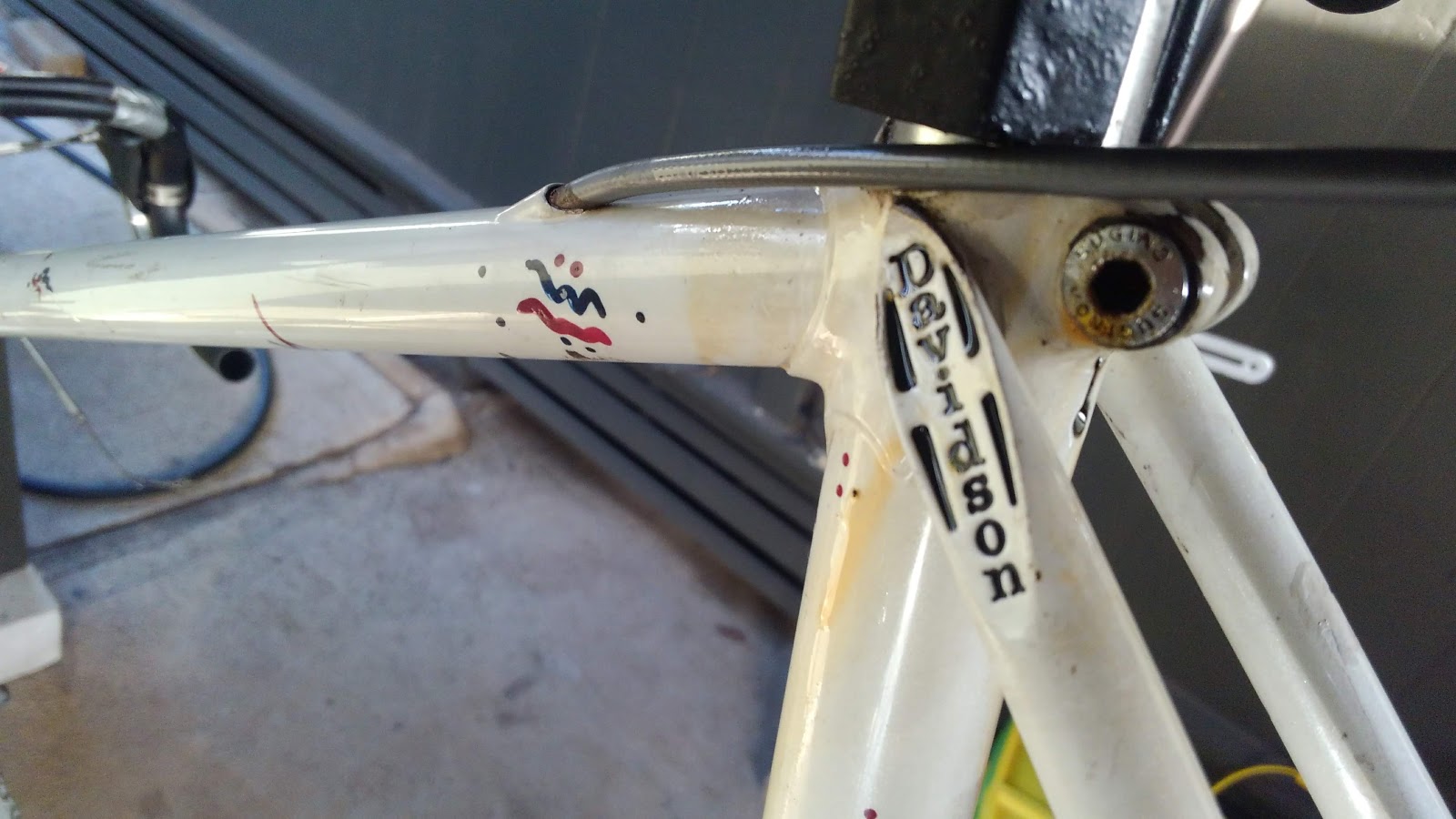
Davidson frame pics

When I decided to take on the task of restoring my old Davidson steel frame road bike I wanted to know if frame decals were still available. I was not even sure that the company still existed. Google informed me the company website was still up, and it looked to me as though Bill Davidson was still working. I reached out through their contact link and Bill himself replied. How cool is that?

These days Bill makes most of his bikes from titanium. He is definitely not a fan of carbon fiber. But for many years he made his bikes from steel. Mine is an Impulse. You can read about it on the Davidson website history section. Scroll down a bit and you will see a section describing the Impulse. Click it to enlarge. That is what my bike looked like when I bought it. I feel kind of bad I upgraded to STI shifters. The plan is to restore to as original as practical.

Today I dropped the frame and fork off at Jimmy's, the painter recommended by Dorian. He says he can duplicate the confetti look, which will do a lot to make the bike look original.

The rest of this post is just a place to hang a bunch of pictures I took for reference. Stay tuned as this project rolls forward.


Tuesday, September 18, 2018

Keeping it fun


Something I have heard from many coaches is the importance of keeping the fun in your training sessions. As a newcomer to the world of structured workouts typical of triathlon training I never found this necessary. Just getting out there and doing whatever was demanded of me was enjoyable enough. Even when the effort got hard, my overall attitude was satisfaction, if not downright happiness.

As time went on my attitude towards training gradually changed. The process is so insidious that I never really noticed. What was once new and exciting became routine. Another swim in the pool. Another run up Diamond Head. Who could imagine that swimming, biking, and running in such a beautiful place would feel routine?

I never stopped training. Sure I had to back off every now and then, like I did last week when I had a wart removed from my big toe. I guess for me training became a commitment. Coaches talk about that, too. The need to get their athletes to commit to their goals. The frustration of coaching someone who says they want to do a 70.3 Ironman but consistently cuts or skips workouts. What can you say to motivate someone like that? At what point do you give up? Wait for them to fail miserably on race day, then say "I told you so?" Nobody wants that.

Real commitment comes from inside, a place very close to what we often refer to as ones heart. Far more than a decision to do something, real commitment is an extension of our innermost self. You know this is true by the emotions associated with the decision. Going to the mall for a pack of CR2032 batteries? No big deal. Drop in at your favorite triathlon shop to purchase a new Garmin FR935? That will trigger some commitment angst in me. Buying a new bike? Lots of emotion there. Getting married? Over the top, as it should be due to the level of commitment involved. Nobody tells you to feel that way. It is not something they teach you at school. Those emotions run deep, and the stronger they feel the more committed you will be.

Commitment is great for staying on course, even on the long path to a difficult goal like a race that is still six months off in the future. As useful as it is, commitment alone to one grand goal is seldom enough. I find it helps to break a large goal into smaller, intermediate goals, and committing to those. Eat the whale one bite at a time.Even then the process will become stale. The cure? Put some fun back into it.

Recently I stumbled onto a great way to accomplish this. I am restoring an old road bike I have had stashed away for years. A handmade Davidson I bought from the original owner way back at the start of my late-in-life cycling hobby. Bill Davidson is still making bikes in Seattle. His current offerings are all titanium, but back when mine was made they were steel. Hand cut, hand welded, hand finished. The seller told me the only way to get one was to visit the Davidson shop, which he did. I paid $600 for it, more than I was planning to spend but a bargain considering what it cost new.

When I bought it back around 1996 it came with, as far as I can tell, a Shimano Dura-Ace 7400 group set, with down tube snifters. It had mismatched Mavic wheels, because the owner raced in crits and broke the original rear in a hard crash. He loved the bike and I can see why. The geometry is tight and it corners like a sports car. After a year or two the rear shifter indexing broke, most likely a victim of one of those hard crashes, so I decided to convert from down tube to STI shifters, new Dura-Ace clipless pedals, and some other bits like a fancy titanium stem and Dura-Ace wheels. I think the nine speed cassette that is on it now is original, but it may have come with an eight speed.

I will be posting more details as the restoration progresses. The point I am making today is that this is something I can have fun with and still incorporate into my cycling activities. I am not planning to win any races with this bike, only to have fun riding it. No pressure, just fun.

Here are some pics of the early stages of dismantling.


Tuesday, July 10, 2018

Experiments in Running Faster


My number one take away from my Honu performance last month was that I need to go faster in all three events. No sense focusing on the run if I cannot make the swim or bike cutoff times. Likewise, no sense overloading the bike training if I fail to finish the swim in time.

For the swim, the late Terry Laughlin would say forget about trying to get stronger. Focus entirely on better form and technique; the strength will happen. I think this works well for full time swimmers who can get to the pool at least five times a week. For a time crunched working triathlete like me there just isn't that kind of time to devote to any one activity. Thoughtful use of strength training can really help here. I have devoted one of my two weekly strength training sessions to upper body development, tailored by my trainer to apply to swimming and running. I hope to add in some good old fashioned arm exercises using stretch bands, like I learned from Peter Hursty.

The key to improving my bike time is to increase my Functional Threshold Power (FTP), and, right behind that, fatigue resistance. Having just finished my "A" race for this year and with nothing special until the Honolulu Marathon in December, conventional wisdom would have me drop back down to base training. I certainly do not intend to abandon those long aerobic threshold rides. My plan is actually quite simple, and follows common practice. Be sure to do one long aerobic threshold ride, one short but hard interval ride, and one or more short to medium distance recovery rides per week, with some cut back every third week. My training leading up to Honu was too focused on long and slow.

Improving my run presents the greatest mystery. I feel like I have tried all the usual stuff, without success. This could be an example of training response outliers, how some individuals do not respond to training stress the way average bodies do.

I am lucky enough to be able to afford most of the available training gizmos. I try to restrict myself to reasonably sane stuff -- no crazy thin shoes, no drag chutes, no copper mesh knee braces. One slightly crazy gizmo I have is a Stryd running power meter, and I find it extremely valuable. This is still a young field, not nearly as well understood as bike power meters. The well respected Dr. Andrew Coggan did a nice presentation on the subject back in 2016, when it was just getting started. This video is a must-see for anyone even slightly curious about running power.

In order to run faster there are two, and only two, physical actions to address. One is stride length. The other is stride rate. It is important to look at many other factors, from head position to foot turn-out, but only stride length and stride rate make any significant contribution to speed. From what I have gathered, a focus on increasing stride rate -- otherwise known as cadence -- is far more likely to produce a useful increase in speed.

The key to increasing stride length is to increase vertical oscillation.  As the body moves forward over the planted foot the leg pushes up through the hip and lifts the runner toward the sky. For a brief moment after the planted foot leaves the ground the runner is flying through the air. Both feet are off the ground. Technically this is called the flight phase. Makes sense. A moment later, the recovering foot makes first contact with the ground, starting the cycle again on the other side of the body.

Unless the runner has attached helium balloons to their shorts, or added wings to their arms, when they are flying they are also falling, at a rate of 32 feet per second, squared. During every foot plant push up cycle the body must rise exactly as much as it falls during the flight phase. If it were possible to increase how high the body goes with each push upward without changing anything else, the runner's speed will increase. Or, it may be more useful to look at it the other way around. If the rate at which the feet hit the ground remains constant, the higher the runner goes the longer the round trip up and down will take, therefore the distance traveled with each stride will increase, and this can only happen when the speed increases. As good as this sounds, it comes with a high price. It takes a lot of energy to launch a body up into the air. The heavier the body, the more energy it takes, and to me this feels like an exponential increase.

In order to run, the body must experience some vertical motion. Increasing cadence is a way to minimize vertical motion. Remember, the body falls at a fixed rate 32 ft./sec2. The shorter the time the body is falling, the shorter the distance it falls, and therefore the shorter the distance it must be pushed upward with each stride. While keeping speed constant, a faster cadence can result in a smoother, less bouncy stride.

Another, somewhat related, aspect of running with increased cadence is better use of tendon elasticity. As the foot plants and starts to bear weight, a whole bunch of tendons spread throughout the feet, and more impotently the legs, start to stretch. The foot should land just in front of the runner's center of gravity, and as the body moves forward over the foot the stretch increases as the tendons absorb the shock of landing. As the body moves past the center of gravity the energy stored in the tendons is released, contributing significantly to upward and forward motion. When a runner jogs at a slow cadence the bounce is wasted. By the time the body is ready to shoot upward, the stored energy has already been released, leaving most of the work to the muscles. At right around 80 RPM (some call this 160 because they count every foot strike) the timing of the energy release begins to align well with the body motion. I think of this effect as resonance, but that might be wrong. What I feel is best described as flow. The word float also comes to mind, but flow is more descriptive. I have no idea where the upper limit is, but the effect seems to continue well past 90 RPM.

I am sure there are other benefits to running with a faster cadence, but I will stop here. It is obvious to me that this is something to look into. So, why is this even an issue? Because when I run at a cadence of 80+ my heart rate climbs steadily up into the red zone. The only way I have been able to sustain a long run is by running at around 75 RPM. That slogging pace is too inefficient.

Last year I assumed that if I ran more I would improve. I ran more, and saw no improvement. It was right after Honu, where I never even got the chance to run, that I found inspiration. A friend had expressed an interest in getting started running. I recited the usual stuff, about starting easy, being consistent, gradually increasing the distance of each run and avoiding the temptation to go right out and run a 10K. I recalled how it was for me, running thirty minutes a day, at lunchtime. Run as long as possible, then walk until I could run again. For months I was envious of the runners who flew past me and kept on going. I could only sustain a run for a minute at most, and would need to walk two or three minutes before I could run again. Gradually the run interval got longer, but then it plateaued. I could run for as long as three minutes, but sooner or later I just had to stop and walk. I was sure I could never get past this point, that I was never going to be able to run a marathon. Then, one day, it happened. I did not have to stop. I don't think I ran thirty minutes non-stop, but it was a whole lot longer than I had been doing.

In order to teach my body how to run, I had to run, even though I could not run. By pushing my body to a higher intensity than it was accustomed to and holding that level for as long as possible I was able to develop the strength and neuromuscular ability to run. My inspiration? Use the same approach to increase my run cadence.

Those beginner runs were limited to thirty minutes. Just enough time to impart a little training stress without causing injury. I already have good endurance, so there was no need to start completely over. A good rule of thumb for long runs is to limit the duration to two hours. Anything lasting longer  invites over-use injuries, and at the very least generates so much fatigue that effective workouts are impossible for the rest of the week. The rules I came up with are simple:

  1. After warming up, aim to keep cadence above 80 RPM.
  2. When candence drops to 75, or heart rate goes well into zone 3, walk.
  3. When heart rate falls back to zone 1, start running again.
  4. Continue for two hours.

This approach is based on my belief that over the course of several years focused on slow running my body -- nerves, muscles, cardio-vascular system -- has learned to run comfortably -- if it can be called that -- at a slow cadence. Even though the strength is there, the muscles and nerves have not had sufficient practice at moving fast to be able to move fast smoothly and efficiently. In the same way that run/walking got me to where I could run continuously, run/walking at a faster cadence will get me to where I can sustain that effort for long periods of time.

Here is an example of a recent run using this method (click to enlarge). The gray horizontal line marks the top of HR zone 3. What you may not be able to see is how often I struggled to keep my cadence at or close to 80. If it feel to 75 and my heart rate was already high I would start walking. I do not want to reinforce the feeling of running with a slow cadence.


It is too soon to say how this is working. In upcoming posts I will follow up on how this is going, and go into more detail on what I am doing on the bike.

Thursday, June 7, 2018

Honu 2018 Race Report


Right off the bat I must apologize for the lack of recent posts. Especially since this blog is specifically about training for the Ironman 70.3 Hawaii, a.k.a. "Honu." What can I say? Life has been crazy busy, and what time I have to devote to this sport all goes to training; not enough time left over for writing. Admittedly an out-of-balance condition. I hope to do better.

This is going to be a race report, but given how little I wrote about the lead-up I will try to expand a bit and include more about getting to this point.

Let's start with the result. About the same as last time, my first attempt in 2016. A DNF. Just missed the bike cutoff time. As similar as the results are, these two races were worlds apart in how I felt. This year felt much better than 2016. The results do not show this, and I doubt the data will, either. All I can say is in 2016 when I got to my bike in T1 I felt so tired, so completely drained after an hour swim, that riding anywhere seemed impossible. This year, I was tired, but not nearly as much. I was ready to ride. Same at Hawi. Last time I was falling over tired and bonky at the turn-around. This time, tired but still feeling good. Once again on the way back past Kawaihae, on that steep climb that kicks up just before the junction, last time I could barely make it up that hill. I was borderline delirious, way behind on fluids and nutrition. This time it was hard but I felt OK.

Another difference between the two races was timing. In 2016 the cutoff times were based on last swimmer entering the water. On the bike I was only monitoring bike time and did not have enough brain function to add that to my swim + T1 time, and I wasn't sure when the last wave started, so I just kept going until a van pulled up and said I had to stop.

This year, each athlete had their own cutoff time, based on when they started their swim. I used the "Multisport Time" field in my Garmin FR 935 to track my overall time. It displays the elapsed time from pressing start, even through transition and as the activity changes. Nice feature.

As I came down from Hawi toward Kawaihae I could see my bike cutoff time -- five hours and thirty minutes from my start -- getting steadily closer. At one point I had enough brain function to calculate that to reach the bike finish from there in time I would have to average 20 m.p.h., and since that was not possible I knew my day was done. That is why, when I got to the next aid station at the 270-19 junction, I just got off and announced I was abandoning. No sense beating up my legs any longer. I had considered riding on, but I doubt I could have gotten as far as the fire station when the course would close and I would be picked up anyway. Like last time.

Why were my times so similar? It may be because I followed the same training plan. The plan I use is by Joe Friel, the well respected master coach and author of the Triathletes Training Bible. He also wrote Fast After 50, and my plan was specifically designed for older athletes.

A term often kicked around in discussions about training is "specificity." The idea is to do workouts that closely resemble the demands of the event you are training for. The Honu bike course is exceptionally challenging in that it is never flat, and it includes some long steady climbs that feel as though they go on forever. To me what is more challenging than the long, steady climbs are the rollers, where you just get settled into climbing mode when up goes your cadence and you transition to descending mode. For example, below is my ride data from T1 at Hapuna Beach to Kawaihae. The gray shaded line is elevation, always going up or down. Not just rising and falling, like Kalanianaole Highway. This is more like going around and around Diamond Head.


Friel's training plan included a lot of bike tempo intervals, which I did on Ford Island where I could blast along unimpeded by traffic. Very race-like conditions provided the race is on a flat course. Toward the end of the build phase I did switch out the interval workouts for sessions on Pineapple Hill. I suspect I should have started that earlier and done more.

On the plus side, Joe Friel's plan got me to the start line without injury. This is something we often hear, how an athlete struggles to perform because every time they train hard they get injured. It is surprisingly easy to train too hard, especially at my age. Looking back at the race I find myself thinking that I should have done a lot more. Swim every morning. Run every afternoon. Bike every ... well, you get the idea. We age groupers frequently admire pros for having nothing else to do but train and imagine how great it would be to train all day. The truth is, there are limits to how much stress a body can absorb. Too little and there is insufficient improvement. Too much and the body begins to break down. The older we get, the narrower the gap.

I recall one specific example of thinking I should do more. After one of my Pineapple Hill days, when I spent the usual amount of time Friel allotted the the bike that day, two and a half hours,  I felt as though I should have done two more laps. Even one more. And, after the race, my thoughts returned there. Here's the catch. A race like this takes everything you have. It takes at least a week to get back to anything resembling normal capacity. In that same manner, a really hard workout will demand several days of recovery time. Whatever boost to strength and endurance that workout produced will have evaporated. Better to do consistent smaller efforts, with each workout building on the last.

I cannot imagine doing a long course triathlon without support. The role those in the sport call "Sherpa." I give my wife Pattie a lot of credit for supporting me in my quest, not only the day-to-day intrusion of time away doing workouts, not to mention a lot more laundry, but especially the work and stress of traveling, cooking, and keeping me on schedule. I have to say that the meals on this trip were outstanding. One that really stood out was the Sunday steak dinner; no better meal anywhere.


Time for some numbers. Before moving on, let me share with you some data as it stood on race day.

Honu Zones
Swim Pace (sec/100 yards)Bike Power (watts)Bike Heart Rate (BPM)
Threshold 2:53Threshold 130Threshold 147
ZoneRangeZoneRangeZoneRange
13:05 to 0:00110 to 7710 to 118
22:43 to 3:05277 to 1052119 to 131
32:31 to 2:433105 to 1313132 to 137
42:23 to 2:314131 to 1454138 to 146
5a2:18 to 2:235145 to 2065a147 to 150
5b2:08 to 2:186206 to 2395b151 to 156
5c0:01 to 2:087239 or more5c157 to 174

Which brings us to FTP. In the last couple months I was concerned that my FTP was falling. It went from a high of around 160 last year down to 130. I was pleased to see it jump up a bit after Pineapple Hill, almost to 140. I knew I would lose a bit during my taper, and I was accustomed to associating what I felt with what I saw on my power meter, so for the race I left my zones based on an FTP of 130.

What I learned doing Pineapple Hill in May was that I could sustain a climb at a cadence of 50-60 RPM at power zone 6.0 - 6.2 and heart rate mid zone 3. Not all day, but for reasonably long time. Respiration and overall feel were right for HR 3Z. If I pushed the power to high 6Z my HR would slowly follow, all the way up to threshold. I knew that to have any hope of finishing the bike I had to keep HR below threshold, preferably smack in the middle of 3Z, with a some recovery time sprinkled in.

I have heard that when HR and PWR zones are set correctly they read almost identically under sustained efforts. Riding at PWR 2.8Z should produce HR 2.8Z plus or minus 0.1 - 0.2. That works for me on flat ground, but on hills I usually see this split. To put it another way, vigorous hill work will raise FTP, but that increase will not necessarily transfer to riding at speed on a flat course. I suspect this has something to do with the contribution from slow twitch and fast twitch muscles. Sprinters can't climb and climbers can't sprint, and it is not all about weight.

Back in 2016 at the very start of the bike I was shocked to see my heart rate up in 5Z. This time I expected as much, and was not surprised. Last time I practically walked my bike up from T1 trying to get my HR down. This time I just watched the power numbers while giving myself a little rest whenever the opportunity arose.

A funny thing happened to me this year on the swim. I got a cramp. I rarely get a cramp swimming, and when I do it is always a calf. I lost about two minutes treading water while waiting for it to relax, wondering if I should wave over a life guard and abandon. Another swimmer stopped to see if I was OK -- talk about good sportsmanship!

Here is the Garmin map of my swim. Keep in mind that a Garmin has to estimate your location in the water, because it cannot receive GPS signals while underwater and it only comes up out of the water a fraction of a second during the recovery.


Let's assume that the buoy turn points are well defined, in which case the thin red line represents the ideal swim course. The thick blue line is the route I took. My number one goal was to compensate for my tendency to turn left. My second goal was to stay outside the main swim lane. I started in the third wave. I had a thousand swimmers behind me, all faster. I did not want to be kicked and clawed, and I did not want to impede anyone.

Overall I did rather well, much better than some past races in which I would have ended up out at sea. I actually over compensated at the start (marked with a white arrow). I think I was sighting the first lane marker buoy after the turn, thinking that I would end up at the turn buoy. Well, eventually I did. I don't think my correction was that extreme (90 degree left turn?!), probably a Garmin tracking error there. On the back straight I alternated between drifting left and swinging back into the swim lane. Eventually I got what seemed like way too far out (second white arrow) and made a big correction to swim a straight line to the turn buoy. I was so far out I was sure I would miss the swim cutoff time (1:10 from my start).

I kept going, harder than ever. That plus fatigue plus worry about being off course is what triggered the cramp. All I could do is tread water and wait it out. Once that settled own I did OK. I even managed to beat my 2016 time, and I didn't fall on my face getting out of the shore break.

Below is my swim data. Just as we entered the water I could feel my heart rate was too high, so I spent a few seconds getting settled. I spent most of the swim at a HR between 138 an 140, just below my threshold. I don't know how well these correlate, but it sure felt like I was going hard. You see my HR rise as I struggled to get back to the pack, and again even higher on the way to the beach, going all out to try to make the cutoff. I clocked my swim time at 1:06:32, three and a half minutes to spare. Whew!


Back in 2016 I went as fast as possible through T1. This time I decided to be a little smarter. I took a cup of Gatorade at the aid station, sipping it as I went up the path. I took plenty of time to wash the sand off my feet. I even dove into a porta-potty. Lately, when I do my swim-bike-run workouts, I need to pee after the swim. I decided ahead of time to follow that pattern regardless of how I felt, because more than likely I would not feel the need, which might come back to bite me later.

At the start of T1 my heart rate was 151. We're talking zone 5b. Sprinting. It came down a bit, reaching its lowest point of 124 while I was in the porta-potty. By the end, after running the bike to the mount line, it was 139. Grinding up the hill to the Queen K and onward I saw my HR in 5Z and my PWR varying between 3Z and 6Z, exactly as expected. Over the first hour the HR gradually began to make sense, but it often lingered longer in 4Z than I wanted. Again, I went with power, but moderated somewhat by heart rate.

A race report would not be complete without mentioning nutrition. Back in 2017 I was a Hammer fan. I especially liked the idea of carrying my own fuel in a concentrated form. For Honu that year I did what I had done for several long rides and marathons, mixing Hammer Perpetuem in a highly concentrated dilution, one bottle good for four hours. That means I always had to drink water from a second bottle and would need to get that refilled at the aid stations. To supplement that I took one packet of Scratch Labs gels and one Bonk Breaker. I ate the gels as soon as I could after the swim, and saved the bar for after reaching Hawi. I thought my stomach would complain less if I ate during the downhill. What I learned from the results was that this was not enough calories, and my system takes too long breaking down the relatively complex maltodextrin Perpetuem uses for fuel. I also do not recommend eating while descending at 30 m.p.h.

Hammer pings sugar-based fuels as wrong for endurance athletes. Infinit argues the opposite, that sugar based fuels are the easiest for the stomach to convert into fuel. This year I gave Inifinit a try and really liked it. I have a run mix and a bike mix, with more electrolytes in the run mix.

For Honu the on-course sports drink was Gatorade. Seeing as how Gatorade is a lot more like Infinit than Perpetuem is I decided to start the bike and run with a reasonable stash of my drink, then switch to their's when mine ran out. This worked way better than the Perpetuem method, where every drink required lifting two bottles. The race also provided small Cliff bars, and I did eat one, but I carried three Bonk Breakers and ate two. This time I did not wait to get started eating solid food, one more reason why I felt so much better this year.

Something TrainingPeaks started last year are awards for best efforts. For the bike segment of this race I got seven peak performance awards, all first place best performance of 2018.

Best 5 sec HR, 146 BPM
Best 1 min HR, 145 BPM
Best 5 min HR, 144 BPM
Best 10 min HR, 141 BPM
Best 20 min HR, 139 BPM
Best 60 min HR, 137 BPM
Best 90 min HR, 136 BPM

So, yeah, I was working hard! But still not fast enough.

Some unanticipated issues made life a bit crazy earlier in the year, but as you can see from my Performance Management Chart below, by March I was back on track an making steady, consistent progress. This about as perfect a PMC as a coach could ask for. The only problem with it is the numbers are too low. The blue line in particular; a peak CTL of 62 is just not high enough to take on a race like this. According to this table on the TrainingPeaks site, training for an HIM should hit a peak CTL of 80 - 115.


Another number that is useful here is TSS. This is a score calculated from whatever data is available for a workout (power being the preferred metric, and without that, heart rate). Longer durations at higher effort levels produce higher TSS scores; an hour at threshold will score 100, as will two hours riding at moderate intensity. TSS scores for individual workouts are useful, but the data becomes more useful when viewed as a weekly measure. The result should track the rise and fall of your training plan periodization while showing a smooth, steady climb to the level required for the event you are training for.

Below are my weekly TSS scores starting in April through race week.


Weekly TSS
4/2439
4/9421
4/16371
4/23411
4/30435
5/7438
5/14495
5/21378
5/28527

This is a good looking result, but apparently not enough. That same TrainingPeaks article on recommended training volume suggest a weekly TSS score of 700 - 1000. I can't tell if those numbers are minimums, or, more likely, what is required to win your age group.

If I were to start now at 700 per week I would run myself into the ground and possibly end up with an over-use injury. This is something runners often get wrong, suddenly increasing their weekly mileage because they are inspired to get a PR at their next race. What I need to do over the coming months is gradually increase my weekly TSS until I can sustain something closer to 700. Remember, time is a factor. I will be focused on higher intensity, but to get a significant increase in TSS requires putting in more time. Where will I find it, and when will I rest? This is the dilemma every triathlete faces.

Threshold heart rate can go up significantly when starting from a sedentary lifestyle. In my case, after several years of serious training, I cannot expect it to rise much higher. The real battle at my age is to minimize the downward spiral. The best way to do that is with high intensity interval training combined with strength training. On the other hand, FTP -- the power produced at threshold HR -- can be increased with the correct training. I was doing a lot of that last year, when my FTP got up near 160. To be successful at Honu I need more. In the coming weeks I will develop a training plan to focus on this.

Regardless of what your threshold heart rate is, or what your FTP is, the power you make has to move your body. At Honu, on the bike, that means moving uphill. Climbing. There is no easier way to improve climbing performance than to lose weight. This is an endeavor I have not been successful at. At six feet I think my ideal weight is 165 to 170 pounds. For more than a year my weight has been 185 or higher. Why spend all that money on a light bike only to strap on ten pounds of extra weight? I don't have any events coming up, so this is a good time to drop some pounds.

If I pause a moment, step back and think about it, what we do -- everyone who gets out there and moves -- is quite remarkable. Here is a memory from the race that really brings this home. I was at the Hawi aid station, refilling my Torpedo hydration bottle with Gatorade. The middle-aged volunteer who handed me the bottle asked where I was from, how my race was going, hesitated a little, then asked me my age. When I told him I am 68 he nearly fell over. I guess it never occurred to him that old guys like to do crazy things, too.

Wednesday, March 28, 2018

Hapalua is right around the corner


After an all too brief rest following the marathon in December I have been working through Joe Friel's Half Ironman training plan (available on TrainingPeaks), my goal being Honu 2018. Actually he has a range of plans differing by age and number of hours per week. The plans I purchased come in two parts, base and build. Two years ago I purchased the build plan, and since these are re-usable I added the base plan this year. His plans are unbelievably detailed, and align perfectly with his books. Even better, the plans I use follow the advice he puts forth in his book "Fast After 50." I think he needs to add Fast After 65. Or 70. The base plan started December 18th, and the build plan March 12th. On a more serious note, I see he has a new set of plans that incorporate TrainingPeaks Structured Workouts. That option was not available when I bought mine, and should be a real time saver.

Life has a way of throwing us a curve ball every once in a while. It happened to me this winter, when our family plans were turned upside down leaving Pattie and I a month to find a new place to live. Happily we found a really lovely little house up on the hill with a great view of Kahala and the back side of Diamond Head, so for now things are back on track.

It is hard to say how much of an impact a month of lost workouts had on my form. It is not as if I had a bad case of the flu, or a broken leg. If anything I was much more active during that time. Beginning mid-January my days were filled with clearing piles of treasure accumulated over thirty years, sifting and sorting, hauling hundreds of pounds of really great stuff to Goodwill, or as often as not, the dumpster. By afternoon of every day I felt numb with fatigue, the kind I associate with a long race. I lost weight. I swear I got stronger, as if I was working out at a gym every day.

One thing I got from this experience was mental toughness. We had a firm deadline to meet. Making it required us to work long hours, every day. I had to keep going, no matter how tired I felt, no mater how much I wanted to sit down and relax. Quitting was not an option. Very much the kind of mental challenge we feel in a long race. As helpful as it is to read about mental toughness, nothing beats a real-world opportunity to experience it.

When I signed up to do the Hapalua half marathon I fully intended to tweak my training plan enough to have a good outing. Ideally that would mean more runs per week, but triathlon training simply does not allow for that. In fact, I already has just enough speed work in the plan. All I really needed was longer runs on the weekends. This is where that missing month had the most impact; my long run mileage is not what it should be.

On the other hand -- or foot, as it were -- I am keeping two strength training sessions per week, and Coach Dorian and I have made Monday's sessions all about legs. I am starting to feel the difference. Running overall just feels easier, and going up hills does not take as much out of me. At my age (68 as I write), putting in extra time on building muscle mass in the gym is more efficient than long runs, and should produce a better outcome. The aging body just does not want to build or maintain muscle mass. Mindful weight lifting will help.

Saturday, December 16, 2017

It's Honu time!


Next week marks the start of my twelve week base training plan for Ironman 70.3 Hawaii, a.k.a. Honu. I have yet to finish up my marathon review, but I thought it best to get the new training underway without delay.

I am once again following a Joe Friel plan, one specifically tailored for older athletes. Last time -- two years ago -- I did a lot of shuffling to get it to fit my life schedule. This time it looks like a better fit. If you are an older athlete you owe it to yourself to read Joe's book, "Fast After 50."

One area  I will modify is the swim workouts. Joe's swim workouts follow well accepted practice. I'm no expert, but I don't see anything wrong with them. The issue is, I am an ardent follower of Terry Laughlin's Total Immersion method, where every workout is designed to focus on a specific aspect of technique. Terry's philosophy is that swimming strength comes from practicing technique. To this I add Joe's argument that as we age we must work extra hard to maintain muscle tone. For  that I plan on continued reliance on strength training with Dorian Cuccia. As for the swim workouts, I plan get them from this great little book by three of Terry's students, "Fresh Freestyle," by Celest StPierre, Dinah Mistilis, and Suzanne Atkinson, MD. The book includes 99 practices, many with color photos. No more confusion about what to do at the pool for TI swimmers.

In his book "The Triathletes's Training Bible," Joe Friel talks a lot about identifying and working on limiters. A training plan provides a balanced approach to all three disciplines -- swim, bike, and run -- with no idea what specific limiter a particular athlete needs to improve. It is up to me to identify my limiters and adjust the plan accordingly.

The two areas I intended to focus on right way are run efficiency and bike threshold power. Some of that bike FTP improvement will transfer over to the run, but not unless I get my legs moving faster and smoother. To that end I expect to see more tempo runs and track drill sessions than called for in the plan.